
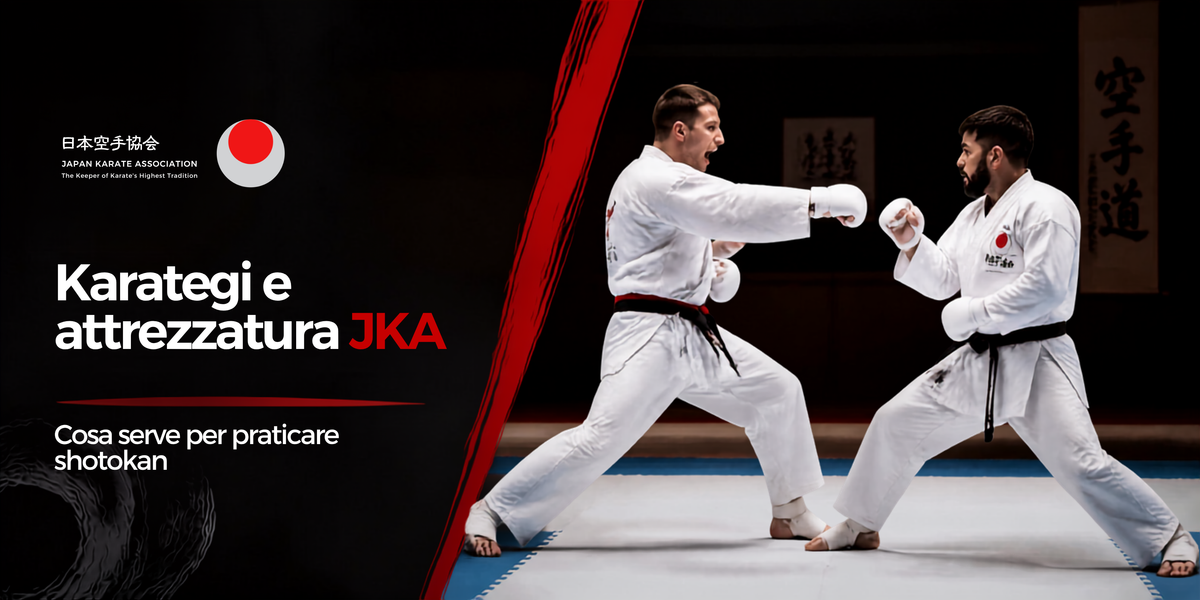
Karategi and JKA equipment: what you need to practice shotokan
Those who sign up for a JKA dojo soon discover that the equipment follows a different logic from that of competitive circuits. No double set of colors to buy. At the center is karategi, and karategi matters by how it behaves under the technique.
Let's see what is needed for those who practice shotokan in the Japan Karate Association, and what the competition regulations ask of those who decide to compete.
1. What is the JKA
The Japan Karate Association, in Japanese Nihon Karate Kyokai, was born in 1949. In Japan practitioners often call it just "kyokai". It is one of the oldest shotokan karate organizations still in operation, and one of the most influential.
It was founded by the senior students of Gichin Funakoshi, the master who brought karate from Okinawa to Japan. Among them Isao Obata, Masatoshi Nakayama and Hidetaka Nishiyama. Nakayama assumed the role of chief instructor. Funakoshi, then in his eighties, retained a position as chief instructor emeritus.
The JKA is not part of the Olympic circuit and is not recognized by the IOC. Its competition regulations apply to the world championships, national championships and local tournaments organized by the dojos. In Italy the activity is coordinated by JKA Italy.
2. Karategi: what the regulation requires
The starting rule is in three words: white, smooth karategi, without decorations. From there the regulation goes into detail about the measures, and they are measures that the referee looks at before the fight.
-
Jacket sleeves: at least halfway up the forearm, and no further than the wrist.
-
Jacket Length: with a knotted belt, up to mid-thigh.
-
Pants: two-thirds of the calf down from the knee, and no further than the top of the ankle.
-
Hems: they don't roll up. If the flap is towards the inside, it must be sewn.
This last point deserves attention, because it's what parents who buy a gi with room to grow stumble upon. Rolling up your sleeves on race day is not allowed: if you shorten, sew.
Badges and numbers
The rules allow badges on the left chest, as long as the organization hosting the tournament recognizes them. The badge is therefore a possibility and not an obligation. Numbers and crests provided by the organization must be applied in the indicated position.
Before sewing anything, ask your dojo. The indications vary from tournament to tournament, and a patch sewn in the wrong place will unstitch badly.
3. Because the JKA karategi is heavy
Shotokan works on kime, the concentration of strength at the end of the technique. A heavy and structured fabric returns that moment with a dry sound, the "snap", which the master hears from the back of the dojo. A lightweight fabric absorbs movement and does not return it.
Hence the preference for high weights, which in the JKA concerns daily training and not just competition. In the catalog the two references are the heavy karategi Tokaido Tsunami Silver and the Tokaido Tsunami Gold heavy karategi.
Two practical warnings for those switching from a light gi to one in this category. The first: the heavy gi warms up, and the first sessions are noticeable. The second: it costs more than a training model, so the size must be taken carefully. The criterion remains the height of the athlete, and we talk about it in detail in the guide to choosing karategi.
When is it best to wait?
If you have been training for a few weeks, a heavy karate gi is not your first purchase. You need a lightweight gi that can handle frequent washing as you learn to move. The heavy pattern becomes the correct choice when the technique stabilizes and the master begins to work on the kime.
4. The red band at the waist
Here the JKA distinguishes itself from both competitive circuits. In the WKF the athletes wear red or blue gloves and protections, in the WUKF red or white. In the JKA the distinction passes through a single object: a thin band of red fabric worn around the waist by one of the two athletes. The other fights without.
Good news for those packing their bags: the red band is provided by the tournament organisation, so it's not a purchase worth making. The regulations list it among the equipment needed to set up the competition field, next to the judges' flags and the red and white ribbon, and ask that its size not hinder the fight.
On the field the red side stands to the right of the head judge, and in basic kumite always attacks first.
5. Safety equipment
The rules list three pieces, with one important clarification: they must be recognized by the JKA.
-
Hand gloves. Also explicitly required in the guidelines of semi-free combat, jiyu-ippon kumite.
-
Transparent mouthguard. Color is part of the requirement.
-
Corsage. Prescribed together with the other two in tournaments for boys and girls practicing free combat.
It's worth stopping at the mouthguard. Transparent means transparent: a colored model, even perfect for tightness and comfort, does not meet the requirement. If you are buying for a JKA race, check this feature on the listing before ordering. You can find the models in mouthguard collection, where there are both versions to be thermoformed and ready-to-use versions, more comfortable for children.
Cotton gloves
Those arriving from the competitive circuits expect a padded glove. I White Tokaido cotton gloves they belong to another category: light fabric, minimal protection, almost no bulk on the hand.
The logic follows that of JKA kumite, where the techniques must be performed with control and the rules allow light contact with the target without producing damage. The guard is there to cover the knuckles, not to absorb a full impact. A thin glove allows you to feel the distance and does not turn the punch into a boxing blow.
On a practical level this involves two things. They wash like a cotton garment, so maintenance is easier than that of a padded protector. And they wear out on the knuckles, where they receive friction, so they should be checked with the same attention you pay to a pair of running shoes.
Glasses, braces, bandages
On these points the regulation is clear. Glasses are not allowed in kumite; they can be worn in the kata, as long as they are well fixed. Soft contact lenses and orthodontic appliances are used at the athlete's risk. Those who wear braces need a compatible mouthguard, as well as a transparent one.
Bandages, tapings and support pads for a past injury must be approved by the head judge prior to the fight, and must not pose a risk to the opponent. Rigid materials are excluded: plaster, wood, hard plastic and steel do not fit on the tatami.
6. Female athletes: the white t-shirt is mandatory
The regulations prescribe that athletes wear a plain white t-shirt under the karate gi jacket. Smooth is the word to read carefully: a t-shirt with prints or logos does not meet the requirement, no matter how beautiful it is.
This distinguishes two purchases that are confusing. The JKA women's Tokaido t-shirt and the men's version They are used for travel, seminars and after training. Under the gi in competition you need a white t-shirt without prints.
7. What changes compared to the WKF and WUKF circuits
Three differences touch the wallet, and they are worth knowing if you train in a JKA dojo and consider competing elsewhere.
The colours. In the WKF you need gloves and foot guards in two colours, red and blue. In the WUKF in red and white. In the JKA the distinction passes through the red band, which provides the tournament, so the double allocation does not exist and does not weigh on the budget.
The number of pieces. The JKA safety equipment can be counted on one hand: gloves, transparent mouth guard, vest. In the WKF there are six mandatory protections in kumite, with additional rules for under 14s and female athletes.
Recognition. All three systems require equipment approved by your organization. The way of verifying it changes: in the WKF and WUKF circuits you look for the label on the product, in the JKA the reference is the recognition of the organization, so you ask the right question to the dojo or the tournament organizer.
If you sign up for competitions on those circuits, the JKA kit is not enough. We have lined up the requirements in two separate guides: mandatory protections in karate competitions for the WKF and the guide to WUKF kimonos and protections for the other circuit.
8. The rest of the bag
In addition to the gi, the kit of those who frequent a dojo continuously is reduced to a few objects that last for years.
-
The bag. The Tokaido JKA backpack bag bears the organisation's branding. A heavy karategi takes up space, so capacity matters more than compactness.
-
The towel. TheTokaido microfibre towel dries quickly and takes up little space. With a heavy gi you will use it every session.
-
The t-shirts. Useful off the tatami, as mentioned above. Under the gi in competition the athletes wear a smooth white t-shirt.
One last note that concerns the appearance and not the equipment. The regulation requires short nails, clean hair and no extravagant colors, and prohibits hair clips made of plastic, metal or with colored ribbons for decorative purposes. Elastic bands and fabric bands remain permitted.
Frequently asked questions
What is the JKA?
The Japan Karate Association, Nihon Karate Kyokai in Japanese, is a shotokan karate organization founded in 1949 by senior students of Gichin Funakoshi, including Isao Obata, Masatoshi Nakayama and Hidetaka Nishiyama. It is one of the oldest still in activity and is not part of the Olympic circuit recognized by the IOC.
What protections are needed in a JKA race?
The regulation lists three pieces of safety equipment, recognized by the JKA: hand gloves, transparent mouth guard and vest. Gloves are explicitly required in semi-free fighting, and the three pieces together in tournaments of boys and girls practicing free fighting. Protection is not used in the kata.
Does the mouthguard in the JKA have to be transparent?
Yes, the regulation requires a transparent mouthguard. A colored model does not meet the requirement, no matter how good the seal. Check the feature on the product sheet before ordering, and if you wear orthodontic braces look for a compatible model.
How do athletes stand out in a JKA race?
One of the two athletes wears a thin band of red fabric around his waist, of such a size as not to hinder the fight. The other fights without. In official JKA competitions the armband is provided by the tournament organization, therefore it does not need to be purchased. The judges use red and white flags, and on the field the red side is to the right of the head judge.
What measurements should the karategi have in a JKA competition?
White and smooth. The sleeves cover at least half the forearm and do not go beyond the wrist. The jacket, with a knotted belt, reaches mid-thigh. The trousers cover two thirds of the calf going down from the knee and do not go beyond the beginning of the ankle. The hems cannot be rolled up: if the turn-up is towards the inside, it must be sewn.
Is the JKA badge on the chest mandatory?
The rules allow it on the left chest, as long as the organization hosting the tournament recognizes it. It is therefore a possibility and not an obligation. Numbers and crests provided by the organization must instead be applied in the indicated position.
What do female athletes wear under their karate gi?
A smooth white t-shirt, which the regulation requires. T-shirts with prints and logos remain for commuting and after training.
Is JKA equipment good for a WKF or WUKF race?
The two circuits require equipment approved by their federation and in the colors assigned to the athletes, red and blue for the WKF, red and white for the WUKF. The JKA kit does not meet these requirements. If you plan to race on those circuits, read the dedicated guides before buying.
In summary
In the JKA the equipment focuses on one object: the karategi, white, smooth and chosen for how it conveys the technique. The sleeve and trouser measurements are written in the rules and the referee looks at them. The safety equipment is reduced to three pieces recognized by the organization, and the red band is given to you by the tournament. The expense you incur is vertical, on a better gi, rather than horizontal on dual color outfits.
Find Tokaido heavy karategi and JKA equipment in the karategi collection. Before ordering a heavy model, ask your instructor if it is the right time to switch: on this purchase his opinion is worth more than any guide.
References: Japan Karate Association, Tournament Rules & Regulations, last revised April 1, 2025, and Tournament Rules & Regulations for Officials, with specific guidelines for kihon-ippon kumite, jiyu-ippon kumite, jiyu kumite, and kata tournaments. Information on the organization from jka.or.jp and jkaitalia.it. The information provided is for information purposes: for the competition requirements, the regulations in force on the date of the competition are valid, to be verified with your dojo or with the organization hosting the tournament.
