
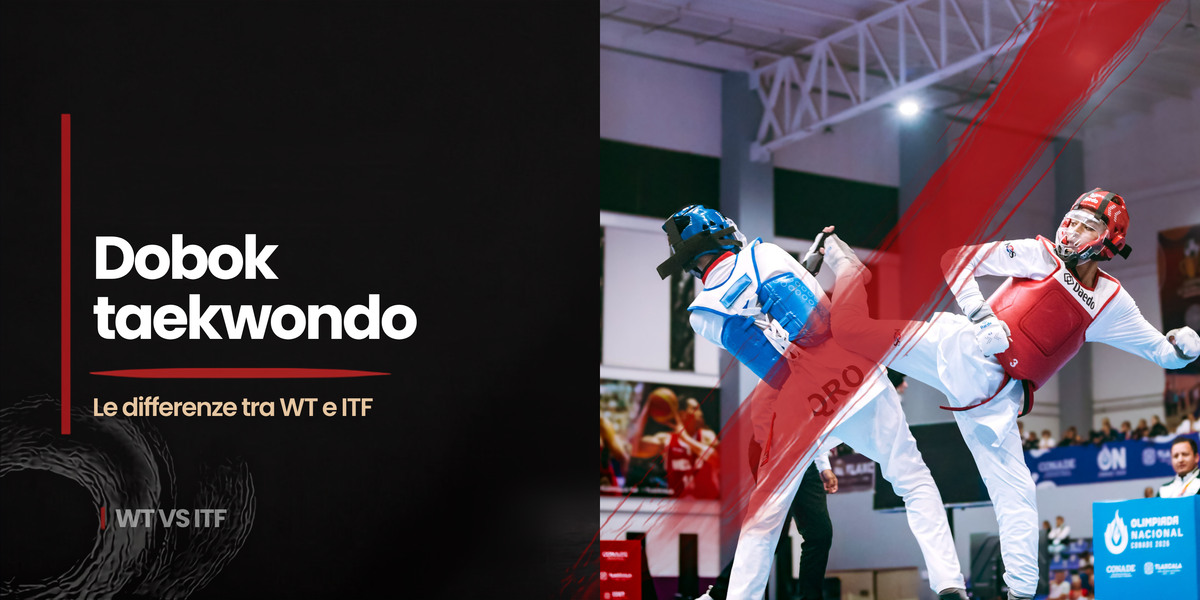
Dobok taekwondo: the differences between WT and ITF
Two taekwondo practitioners may train in the same city, wear a white uniform and belt of the same color, and buy different equipment. It depends on the federation. WT and ITF have separate histories, separate regulations and a visually recognizable dobok.
Let's see what each regulation asks for, piece by piece, and where the two differ the most.
1. What is taekwondo
The Korean word is divided into three ideograms. Tae means to kick in flight, Kwon fist, Do art. Literally: the art of flying kicks and punches.
The techniques are based on the principles of Newtonian physics applied to power generation, with fluid movements that arise from each other's ends, without sudden stops. General Choi Hong Hi established some criteria that are still valid as a measure of technical correctness. Two deserve a mention. The principles behind each technique must be so clear that even non-practitioners can distinguish a correct movement from an incorrect one. And every movement must remain harmonious and rhythmic, because taekwondo is also an aesthetic art.
2. WT and ITF: two federations, two paths
The most immediate distinction lies in the name. The ITF world writes Taekwon Do with the hyphen, following General Choi's handwriting. WT World writes taekwondo united. When you read a site or a poster, the hyphen already tells you which circuit you are in.
World Taekwondo governs Olympic taekwondo. The International Taekwon-Do Federation descends from General Choi's original codification. In Italy the ITF circuit passes through FITAE-ITF, the WT one from Taekwondo Italy.
One point in common, before the differences: both regulations assign corners to the athletes red and blue, and in both the protections follow that color. Those coming from karate will recognize the WKF system.
3. The WT dobok and its protectors
The WT regulation talks about two items, the dobok and the competition uniform, and requires that both be approved by WT. The same rule applies to all equipment allowed on the field.
The difference between the two garments concerns where the limb protections are worn. With the dobok, the forearm and shin guard go underneath. With the competition uniform they can be worn over the top or underneath. The shell goes under in both cases.
In the catalog the reference for combat is Daedo Competition WT dobok with white neck. Whoever begins finds inAdidas Adistart WT approved an entry model. We talk about poomsae, which has its own regulations, in section 5.
The complete list
Before entering the field the athlete puts on electronic vest, electronic helmet, shell, forearm guard, shin guard, gloves and, when using the electronic system, i sensorized shoes. He has with him the mouthguard. The helmet is worn under the left arm upon entering the area, and is worn on the referee's instructions.
In the catalog you will find the Daedo electronic armor, i WT approved Daedo gloves, i Daedo armguards WT approved and the foot guard with 15 sensor foot protector. For the shell there are the Daedo model WT approved and, for female athletes, the versions Daedo woman e Adidas approved WT. Lo scudetto it is applied on the dobok.
A clarification that changes the shopping list: the organizing committee prepares the electronic bodice and helmet, the carpets and a reserve supply of the rest. The athlete brings his own protective equipment, gloves and mouth guard.
The WT mouthguard has precise specifications
-
Color: only white or transparent.
-
Thickness: at least 3 mm.
-
Coverage: the entire upper arch.
-
With orthodontic appliance: you need a braces model that covers both arches, recommended by your dentist, and a letter from your dentist certifying the safety of use in competition must be submitted.
A colored mouthguard does not pass inspection, no matter how good the seal. You can find the compliant models in mouthguard collection.
Helmet and controls
The color of the electronic helmet is limited to blue and red, and a different color excludes you from the competition. For cadets the helmet can have a visor, and at the cadet world championships the traditional helmet with visor is used: in the catalog the version for the youngest is the Daedo children's helmet with WT approved visor. For adults there is the WT approved Adidas helmet.
Nothing is worn on the head other than the helmet. Religious objects are worn under the helmet and inside the dobok.
At the pre-race check three situations exclude participation: protections that cover poorly, of an unsuitable size or with defects in shape or material; non-compliant mouthguard, even during the match; piercings, earrings or rigid material retained after the notice. Taping of hands and feet is checked, and for excessive taping the inspector may ask for doctor's approval.
4. The poomsae WT: a separate regulation
In the WT circuit, poomsae has its own rules, distinct from those of fighting. It is worth knowing the structure, because it is the context in which poom dobok are used.
Competitions are divided into three types: poomsae recognized, free style e mixed poomsae. An athlete can register in two categories, if gender and age allow it. In mixed poomsae, a recognized poomsae is performed first, then a free style.
Age divisions
In the recognized individual poomsae there are eight bands: cadets 12-14 years old, juniors 15-17, and then under 30, under 40, under 50, under 60, under 65 and over 65. For couples and teams the bands are merged. In free style there are two: under 17, which includes from 12 to 17 years old, and over 17.
This explains a characteristic of poomsae that surprises those coming from combat: it competes at any age, with categories also designed for practitioners over sixty.
How the race takes place
-
They are carried out two poomsae among the mandatory ones indicated for your division, in all rounds, from the preliminary rounds to the final.
-
Obligate poomsae grow with age and range. Individual cadets work on Taegeuk 4th through 8th plus Koryo, Keumgang, and Taebaek. Moving up the ranks, Pyongwon, Shipjin, Jitae, Chonkwon and Hansu enter.
-
Duration: up to 90 seconds for recognized poomsae, between 90 and 100 seconds for free style.
-
Between the first and second poomsae pass at least 30 seconds.
In free style the execution line, the music and the choreography are chosen by the athlete, but the techniques must remain within the perimeter of taekwondo: those that are not are penalised. In mixed teams, board breaks are expected in three technical skills, including the spinning kick and consecutive fighting-style kicks.
The doboks from poomsae
In the catalog you will find the poom dobok in the women's versions white and blue e white and red, the Poom Grand Master gold and black, the WT approved black dobok with embroidery on the back and the WT approved colored Hi-Tech Daedo.
It is important to be clear on one point: which uniform belongs to which category is established by the rules on clothing, which are a separate chapter from the one describing the progress of the competition. Before ordering a dobok from poomsae, ask your instructor which model is intended for your division.
5. The ITF dobok and its protections
The ITF regulations require that competitions be held in ITF approved doboks, and on the dobok establishes precisely what should be applied and where. The basic model is the ITF student Daedo dobok; for those who teach there are the instructor approved dobok, the master model with black bands and the version Hi-Tech with black edges.
-
Right chest: national flag, official coat of arms or national badge of the country represented, measuring no more than 4 x 8 cm, at the same height as the ITF logo. Signs that do not fall into these categories are prohibited.
-
Left sleeve: the logos of the national federation or sponsors, centered between the shoulder and elbow.
-
Grades 4th and 5th dan: Instructor doboks with black stripes on the sleeves or trousers are not worn during the tournament.
This last point is a real purchase warning. If you are 4th or 5th dan and buy an instructor's or master's dobok with black bands, you cannot wear it in tournaments. You also need a pattern without lines, and it's worth clarifying that before you double-spend.
The belt, with the measurements
Here the ITF regulation goes into a detail that the WT document does not touch on. Black belt measures 5 centimeters wide and 5 millimeters thick. The grade marking goes on the left edge, with the base 5 centimeters from the end. Knotted, the two ends must not exceed the middle of the thigh.
And there is a surprising rule: if the belt comes undone three times during the competition, the athlete is disqualified. Showing up with a dobok without a belt inside the tournament venue is also punishable. A correctly sized and well-tied belt ceases to be a detail.
In the catalogue ITF black belt embroidered in gold and the Fujimae two-tone belt for intermediate grades.
Protections for combat
All protections must be ITF approved. The list:
-
Gloves closed type, in good condition, closed with velcro. Gloves with laces are prohibited. In the catalog i ITF approved gloves, available in red and blue.
-
Mouthguard and helmet. The helmet must cover the entire head except the face: see ITF approved competition helmet and the ITF Daedo helmet.
-
Breast protector for female athletes, under the dobok jacket.
-
Shell for male athletes, under the dobok pants, like the Fit Sport ITF men's shell. Additional protectors for the chest, ribs, abdomen and forearms can be worn under the dobok when needed.
-
Shin guard for everyone: i Daedo approved ITF shin guards.
-
Hand and foot protection in red or blue, depending on the assigned angle. For the feet there are the ITF approved Daedo shoes and i Fujimae ProSeries footguards.
A note on the breast protector: the regulation prescribes it for female athletes and at the moment it is not in our ITF selection. If you need it, write to us before the race.
Beware of a confusing product. I ITF Advantage open hand gloves they are a training item: the regulations require closed-type gloves for fighting, so gloves are needed in competition.
To carry everything there is it Daedo TKD ITF backpack.
The weight of gloves changes with age
This is the most operational data of the entire ITF regulation, and it is best to have it in mind before ordering.
-
From 8 to 13 years (Pre-Children, Children and Cadet tournaments): gloves 8 or 10 ounces.
-
Ages 14 and up: gloves from 10 oz, and only from 10.
One ounce is 28.35 grams, so the difference between 8 and 10 ounces is approximately 57 grams per hand. It can be felt on a twelve-year-old boy.
ITF bans
On this front the ITF regulation is more restrictive than the WT one, and on one point it goes in the opposite direction.
-
No protective masks or face coverings of any kind in combat, without exceptions for medical or other reasons. In the WT circuit, however, the cadet helmet can have a visor.
-
No hand bandages and no under-gloves of any kind in combat.
-
No hard or sharp-edged materials in protections: metal, bone, rigid plastic. Zips, decorative laces and snap buttons are also prohibited.
-
No watches, jewelry or ornaments. Hair clips or barrettes are not permitted for female athletes; rubber bands yes.
-
Blood stained equipment must be replaced with clean equipment before the next shift. The same goes for dobok.
Bandaging or bracing following an injury requires the permission of the official tournament doctor or the ITF medical committee, and the material used must not give an advantage or disadvantage.
6. WT and ITF compared
|
Element |
WT |
ITF |
|
Uniform |
WT approved dobok or competition uniform |
ITF approved dobok |
|
Badges |
No headgear other than the helmet; religious objects below |
Flag or coat of arms 4 x 8 cm on right chest; logos on the left sleeve |
|
Belt |
Not specified in the document |
Black 5cm x 5mm; untied 3 times leads to disqualification |
|
Athlete colors |
Red and blue |
Red and blue |
|
Gloves |
WT approved, worn by the athlete |
Velcro closed type; 8 or 10 ounces up to 13 years old, 10 ounces from 14 |
|
Head |
Blue or red electronic helmet; visor for cadets |
Helmet that covers the entire head except the face; masks prohibited |
|
Mouthguard |
White or transparent, at least 3 mm, upper arch |
Mandatory |
|
Trunk |
Electronic certificate provided by the organization |
Breast protector for athletes; optional additional protectors under the dobok |
|
Shell |
Under the head |
Under pants, for male athletes |
|
Shin guard |
Under the head with the dobok |
Mandatory for everyone |
|
Hand bandages |
Controlled taping, medical approval if excessive |
Forbidden, like under-gloves |
|
Who provides what |
Electronic bodice and helmet from the organization |
The athlete brings everything |
7. What to look at before buying
First the federation, then the model. A dobok is a garment built to a rulebook, and the two rules ask different things. Buying it before knowing which circuit you will train on leads to a purchase that will have to be made again.
In the ITF check the age on the glove sheet. Weight is prescribed and changes at fourteen. A boy who turns fourteen once the season has started moves up to 10 ounces.
In the WT the mouthguard comes before comfort. Color and thickness are written in the regulation and control them. If you wear braces, move in advance: you also need a letter from the dentist.
In the ITF, if you are 4th or 5th dan, look at the bands. Instructor's and master's doboks with black lines are not worn in tournaments at those ranks. You need a second dobok without lines.
The size is taken based on height. It applies to the dobok as well as to the karategi, and the criterion is the same as that which we explain in the guide to choosing karategi.
Frequently asked questions
What is the difference between WT and ITF?
They are two distinct international federations, with separate histories and regulations. World Taekwondo governs Olympic taekwondo; the International Taekwon-Do Federation descends from General Choi Hong Hi's codification. The ITF world writes hyphenated Taekwon-Do, the WT world writes united taekwondo. Doboks and protectors follow different regulations and must be approved by the respective federation.
Are the WT dobok and the ITF dobok interchangeable?
No. In the WT circuit the dobok must be approved by the WT, in the ITF circuit by the ITF, and the two regulations prescribe different elements. The ITF dobok carries the national flag on the right chest and logos on the left sleeve, with measurements and positions indicated. If you change federation, the dobok changes.
What protections are needed in a WT race?
Electronic vest, electronic helmet, shell, forearm guard, shin guard, gloves, sensorized shoes when using the electronic system, and mouth guard. The electronic bodice and helmet will be provided by the organizing committee; the athlete brings his own protective equipment, gloves and mouth guard.
What protections are needed in an ITF competition?
Closed gloves with Velcro, mouth guard, helmet that covers the entire head except the face, shin guard for everyone, breast protector for female athletes under the jacket and shell for male athletes under the trousers. Additional protection for the chest, ribs, abdomen and forearms can be worn under the dobok. Hand and foot guards go in red or blue, depending on the assigned angle.
How is a WT poomsae competition organised?
The competitions are divided into recognized poomsae, free style and mixed poomsae. Two poomsae are performed among the compulsory ones of your division, in all shifts. The recognized poomsae lasts up to 90 seconds, the free style between 90 and 100, with at least 30 seconds of waiting between the two tests. The age divisions reach beyond 65 years.
What weight should gloves have in the ITF?
For ages 8 to 13, 8 or 10 ounce gloves are permitted in Pre-Children, Children and Cadet tournaments. Ages 14 and up 10oz only. Gloves must be closed type and closed with Velcro: those with laces are prohibited.
What should the mouthguard look like for a WT race?
White or transparent, with a minimum thickness of 3 mm, and must cover the entire upper arch. Those who wear braces need a braces model that covers both arches, recommended by their dentist, and must present a letter from their dentist certifying that it is safe for use in competition.
Can protective face masks be used in the ITF?
No. The regulations prohibit protective masks and face coverings of any kind in combat, with no exceptions for medical reasons. In the WT circuit, however, the cadet helmet can be equipped with a visor.
What measurements must the black belt have in the ITF?
Five centimeters wide and five millimeters thick, with the grade marking on the left edge and the base five centimeters from the end. Knotted, the two ends do not exceed the middle of the thigh. If it comes undone three times during the competition, the athlete will be disqualified.
In summary
The question to ask before buying a dobok is about the federation, not the model. In the WT circuit, the WT approval, the white or transparent mouthguard of at least 3 mm and the two-color helmet, with electronic vest and helmet provided by the tournament, count. On the ITF circuit, the ITF approval, the position of the flag and logos on the dobok, the belt size and the weight of the gloves, which changes at fourteen, count.
You can find doboks and taekwondo protectors in the taekwondo section. If you don't know which circuit you will compete on, ask your instructor before ordering: his opinion on this purchase will save you double spending.
References: WT Competition Rules and Interpretation, effective January 1, 2026, for uniform, competitor equipment and pre-competition inspection; ITF Tournament Rules 2026, Article 6, for dress code, general equipment requirements and protective equipment in fighting competitions; WT Poomsae Competition Rules and Interpretation, effective June 14, 2024, for competition types, age divisions, compulsory poomsae and event lengths. Information on the art and technical principles from FITAE-ITF information material. The information provided is for information purposes: for the competition requirements, the regulations in force on the date of the competition are valid, to be verified with your sports club.
